| LexRegPulse |
|
No Noise. Only Signal.
|
|
| MARKETS — as of Nov 18, 6:25 AM ET |
Equity futures Rates Credit & risk
|
|
|
|
FDIC approves OneMain Holdings' deposit insurance for Utah bank The Federal Deposit Insurance Corporation (FDIC) board approved OneMain Holdings' deposit insurance application for OneMain Bank, a Utah industrial bank based in West Valley City. The bank would make unsecured and secured consumer loans and issue credit cards nationwide through OneMain's existing online and retail lending channels. OneMain said Utah's Department of Financial Institutions has also approved the charter. An industrial loan company (ILC) charter lets a parent own an insured bank without becoming a bank holding company supervised by the Fed. The FDIC attached conditions to both the bank and its parent. The bank's minimum leverage ratio is 15 percent. | ▸ | Conditions on the parent: OneMain must support the bank's capital and liquidity positions under written agreements with the FDIC. The agency weighed the application against seven statutory factors, among them risk to the Deposit Insurance Fund and the convenience and needs of the community. The order lapses unless OneMain Bank is established within 12 months; the FDIC can extend that window. The bank is not yet open. |
| ▸ | A contested applicant: American Banker called OneMain embattled. It noted that the Consumer Financial Protection Bureau (CFPB) and state attorneys general have accused the lender of unfair practices tied to its add-on products. |
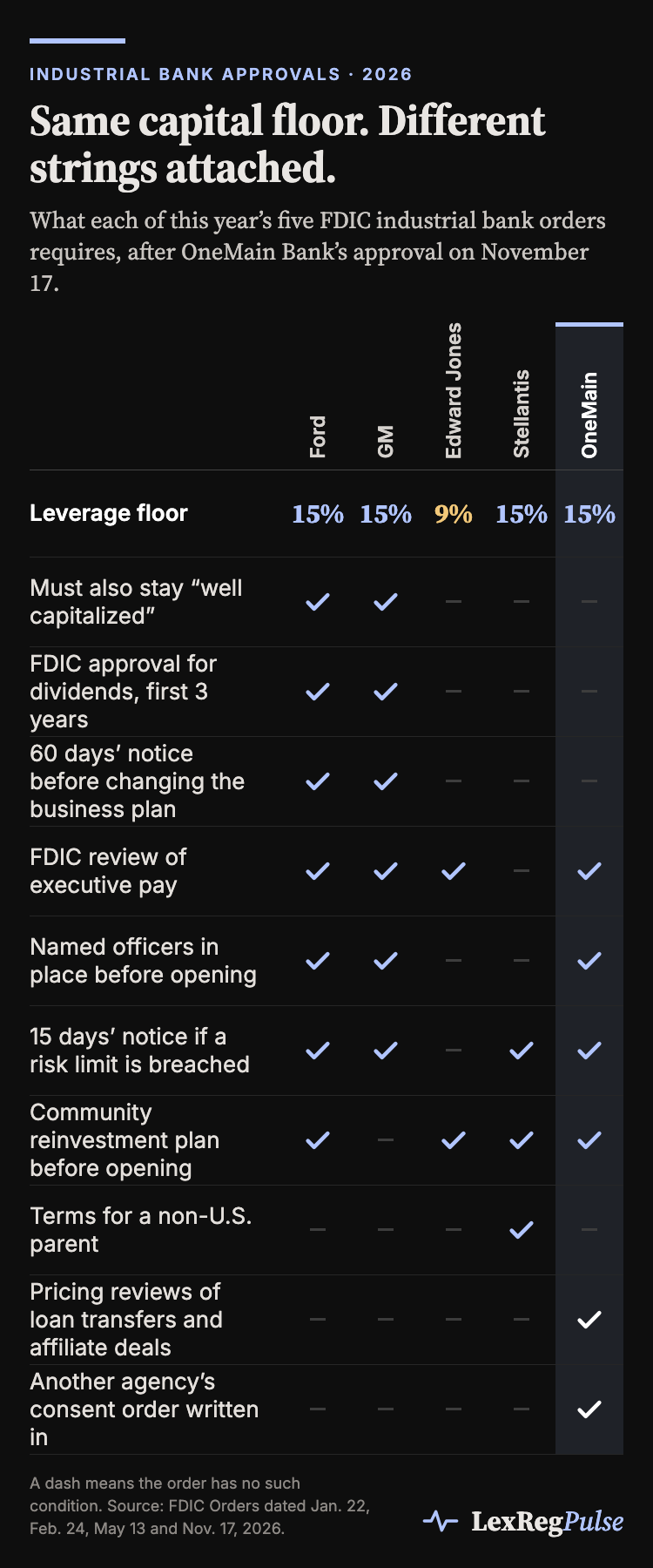
| ▸ | In the Order itself: Condition 20 binds the bank to OneMain's May 2023 CFPB consent order if it finances optional add-on products, and gives it ten calendar days to report any lapse to the FDIC. Conditions 12 and 13 require an independent market value analysis of the loans moved into the bank and a market-terms analysis of three affiliate agreements. Lex compared all five of this year's FDIC industrial bank orders, condition by condition, in a new analysis. |
|
+3
Neutral
→
|
|
|
30-day trend
Nov 18, 6:00 AM ET
|
REGULATORY DEVELOPMENTS Treasury proposed easing how banks verify beneficial owners, and the Office of the Comptroller of the Currency (OCC) and FDIC endorsed the proposal the same day. Revised capital rules reached White House review, and the FDIC proposed a custodial-deposit carve-out for small banks. Governor Waller and Comptroller Gould spoke on payments and charters; an appeals court ruled against Kalshi in Maryland. | ▸ | Beneficial-ownership checks revised: Financial Crimes Enforcement Network (FinCEN) proposed revising its customer due diligence (CDD) rule on November 17 under Executive Order 14406. The proposal would codify existing relief so that banks need not re-identify and re-verify a legal entity customer's beneficial owners each time the customer opens a new account, specify what they must collect on each owner, and expressly allow them to gather more where risk or supervisors call for it. ABA Banking Journal said the proposal would also end the use of individual taxpayer identification numbers (ITINs) for CDD compliance. Comptroller Jonathan Gould backed the proposal, and the FDIC encouraged comment. Treasury Secretary Scott Bessent said the rule "cuts unnecessary burden, gives institutions more flexibility to effectively combat risk, and strengthens our fight against financial crime." Comments run 60 days after Federal Register publication. |
| ▸ | Capital rules at the White House: The OCC has sent the agencies' joint rulemaking to lower capital requirements for banks of all sizes to administrative review, ABA Banking Journal said. American Banker said the FDIC submitted its revised capital rules to the Office of Information and Regulatory Affairs (OIRA), the final step before publication. |
| ▸ | Custodial deposits carve-out: On November 17 the FDIC board approved a proposal implementing section 901 of the 21st Century ROAD to Housing Act. Banks with less than $10 billion in total assets could exclude qualifying custodial deposits from brokered treatment, up to 20 percent of total liabilities; the proposal also sets interest-rate restrictions for some banks that accept them. The board held the Deposit Insurance Fund's designated reserve ratio at 2 percent for 2027. Comments run 60 days after Federal Register publication. |
| ▸ | Waller on tokens and Custodia: Governor Christopher Waller told The Clearing House's annual conference on November 17 that tokenization is sharpening competition between new entrants and established firms. He named customer relationships, network effects and market confidence as competitive advantages. In separate comments, Waller said he was not trying to scuttle Custodia Bank's lawsuit when he floated a limited-access payments account, though the proposal had that effect, according to American Banker. The Supreme Court declined Custodia's appeal on November 16. |
| ▸ | Gould on charters and vendors: Comptroller Gould spoke to the American Fintech Council Policy Summit on November 17, according to an attendee account; no transcript was released. He said the OCC is technology neutral and that being open to new charters means following the statute and licensing procedures, with standards kept high. He said the agency is getting closer to its target timelines for the steps it controls. On third-party risk, he called the existing guidance too prescriptive and said the OCC believes the Bank Service Company Act lets it deal directly with service providers. Interagency third-party comments close December 16. |
| ▸ | Kalshi loses in the Fourth Circuit: The Fourth Circuit ruled on November 17 that Kalshi's prediction market is not a federal derivatives exchange exempt from Maryland regulation, according to Law360. Each judge on the panel wrote a separate opinion. In August, American Banker said a Ninth Circuit ruling for Nevada had split with the Third Circuit, leaving the question for the Supreme Court. |
INDUSTRY AND AI SIGNALS | ▸ | Futures rise after Nvidia: S&P 500 futures rose about 0.5 percent and Nasdaq futures about 1 percent this morning, a move Bloomberg tied to Nvidia's earnings. Nvidia's board said it will not reinstate Jensen Huang as chief executive. The 10-year Treasury yield held at 5.10 percent and the 2-year stood at 4.80 percent ahead of today's release of the October Federal Open Market Committee (FOMC) minutes. Reuters said Fed official Alberto Musalem sees several rate hikes needed by spring; New York Fed President John Williams said now is not the time for dramatic action. October retail sales rose 0.2 percent, the Census Bureau said. Crude fell about 1 percent to near $84 a barrel. The FOMC decides December 9. |
| ▸ | Deutsche Bank leak: Whistleblowers leaked more than 15 million internal Deutsche Bank documents to a consortium of more than 200 journalists, the Financial Times reported on November 17. The FT said the files show almost $600 million in suspicious payments linked to Jeffrey Epstein, an accidental disclosure of President Trump's tax statements during his first term that the bank kept from the White House, and a planned expansion of its Russia business over its compliance team's objections. Deutsche said the issues date back many years and, where relevant, were discussed with regulators at the time. Its shares fell as much as 6 percent before paring the loss to about 4 percent. The FT said a report on the bank's anti-money-laundering systems is still to come. |
| ▸ | Anthropic prices into heavy demand: Anthropic plans to price its IPO at or above the top of its $70-to-$78 range after drawing orders for close to seven times the shares available, Bloomberg reported, citing unnamed sources. Better Markets said the shares are expected to start trading on Nasdaq as ANT on November 19. It added that the registration statement shows nearly $900 billion committed to suppliers, about ten times annualized revenue, most of it not cancellable. The Financial Times examined the data-center bet behind that figure. Pricing is expected today. |
| ▸ | BILL take-private nears: TPG is likely to reach a deal to take BILL Holdings private within days, the Financial Times reported, citing unnamed sources. The payment-automation firm put itself up for sale after its value fell more than 80 percent from its 2021 peak. PYMNTS put its market value at $4.8 billion. |
| ▸ | Cyber Corner Tainted web-testing code: An attacker planted code in web-testing files used by 178 organizations, 32 of them in banking and finance, and briefly affected the HSBC and Associated websites, American Banker said. Security researcher Scott Helm told Reuters that the malicious JavaScript ran through Optimizely and aimed to steal cryptocurrency and infect iPhones. Most of the code was gone by Monday afternoon. |
| ▸ | A week of outages: Apple Pay, iCloud and Gmail had problems on Tuesday and a classified National Security Agency network went down, Politico and CNN reported, after a week of failures at Microsoft, airlines and big banks' online services. Director of National Intelligence Jay Clayton said Tuesday there is no evidence of a cyberattack or a coordinated effort by a nation state, according to Semafor. White House cyber director Sean Cairncross told Semafor the disruptions come from "updating and modernizing legacy systems" and that he expects more of them. Lawmakers in both parties are unconvinced, Politico said. Homeland Security Secretary Markwayne Mullin is due to take questions at a House hearing today. |
POLITICAL & LEGISLATIVE | ▸ | Removal fights at the Fed and NCUA: Through her lawyers, Fed Governor Lisa Cook declined to appear next month before a Trump administration committee considering whether she should be fired. She called the process unfair and its outcome predetermined. Her lawyer, Abbe David Lowell, wrote to White House counsel William Scharf, in a letter released November 17, that she has a duty to the Fed to decline proceedings that would undermine its independence. The administration alleges she committed mortgage fraud in 2021, before joining the board; she denies it. Separately, an appeals court questioned whether fired National Credit Union Administration (NCUA) board members deserve protections like those of Fed governors, CUToday reported. |
| ▸ | Senate majority widens: Mary Peltola unseated Republican Senator Dan Sullivan in Alaska, giving Democrats a 56-44 majority when the new Congress is seated in January. Politico, which reported the result, also reported that former Nvidia chief executive Jensen Huang has agreed to appear before the Senate Banking Committee. Democrats take control of that committee in January. |
WHAT'S COMING | ▸ | Proxy rules close Friday: Securities and Exchange Commission (SEC)-registered bank holding companies have until November 20, two days out, to comment on the SEC's proxy solicitation modernization proposal and its proposed rescission of Rule 14a-8's federal regulation of shareholder proposals. |
| ▸ | FDIC merger proposal closes Monday: Comments close November 23, five days out, on the FDIC's merger transactions proposal (91 FR 60196) and its State Bank Parity proposal. The merger proposal would add deemed approval for de minimis deals and count credit unions in the competitive-effects review; until a final rule issues, the 1998 statement of policy governs. |
| ▸ | Oregon escrow case, Friday: A ruling is expected November 20 on the OCC's motion to dismiss or transfer the multistate challenge to its escrow-interest preemption determination. |
ALSO NOTED | ▸ | The Fed set its 2027 Regulation D thresholds: the reserve requirement exemption stays at $39.2 million and the low reserve tranche rises to $688.5 million. Reserve ratios remain zero. | | ▸ | Mercantile Bank said the FDIC (November 4) and Michigan's DIFS (November 13) approved its merger with Eastern Michigan Bank; the two banks hold about $7.2 billion combined. | | ▸ | Judge Brian Cogan said the merchants' swipe-fee case against Visa and Mastercard goes to trial if he rejects final approval of the settlement, Payments Dive said. | | ▸ | JPMorgan CFO Jeremy Barnum will hand the role to Bregje de Best in April and remain as vice chairman through early 2028, Banking Dive said. |
WHAT IT MEANS | ▸ | OneMain's Order shows the FDIC cutting each industrial bank approval to the applicant's own file. All five of this year's orders share a core: a leverage floor, parent support for capital and liquidity, and three years of FDIC sign-off on board and senior executive changes. OneMain's adds its 2023 CFPB consent order and pricing reviews of its dealings with its parent. The next nonbank parent to apply can expect the core, then conditions drawn from its own record. The Independent Community Bankers of America (ICBA) is already opposing Upgrade's pending application for the same charter. OneMain's order lapses on November 17, 2027 unless the bank is established or the FDIC extends it. |
Dates That Matter Deadlines NOV 18
today | Comments close: Further Definition of “Swap” To Exclude Casino-Style Gambling Products [CFTC] · Further Definition of “Swap”-Inclusions [CFTC] | NOV 20
2d | Comments close: Rescission of Rule 14a-8's Federal Regulation of Shareholder Proposals and Amendments [SEC] · Proxy Solicitation Modernization [SEC] | NOV 20
2d | Watch: D. Or. 3:26-cv-01672-SI: ruling expected on the OCC's Oct 5, 2026 motion to dismiss [Watch] | NOV 23
5d | Comments close: State Bank Parity [FDIC] · Merger Transactions [FDIC] · List of Rules To Be Reviewed Pursuant to the Regulatory Flexibility Act [SEC] |
Hearings & Events NOV 19
1d | Hearing: Business meeting to consider certain pending nominations. [Congress] |
|
|
|
|
|
|
30-Day Document Volume
|
|
|
|
|
|
Today's inputs
| 76 docs | 20 high priority | 49 social | 495 news |
|
Monitoring 118+ sources across federal agencies, state regulators, expert newsletters, social media, and news wires · Methodology |
|
|
Signed
Lex
LexRegPulse Analyst
Primary-source research · AI-drafted · human‑reviewed
Methodology →
|
|
From LexRegPulse
One more thing. The intelligence behind this brief is available for your institution — pointed at your charter, your regulator, and your policies, so the morning read becomes a working compliance program. LexRegulator.com, or reply here.
|
|