FDIC writes a CFPB consent order into OneMain Bank's approval
The FDIC's OneMain Bank order ties deposit insurance to a 2023 CFPB consent order. How its 20 conditions compare with 2026's four other industrial banks.
The FDIC's November 17 release on OneMain Bank reads like the four industrial bank releases before it: a 15 percent leverage floor, parent support for capital plus liquidity, 12 months to open. The Order attached to it says more. Condition 20 writes a 2023 Consumer Financial Protection Bureau consent order into the deposit insurance approval and makes a failure to report a lapse, or to finish the corrective steps the FDIC requires, a violation the agency can pursue under Section 8 of the FDI Act. Conditions 12 and 13 require an independent valuation of the loans OneMain moves into the bank and a market-terms review of the three affiliate agreements that run its originate-and-sell model. No other 2026 order contains anything like them.
By the count of the FDIC's own releases, OneMain Bank is the fifth industrial bank deposit insurance approval of 2026, after Ford Credit Bank and GM Financial Bank (January 22), Edward Jones Bank (February 27) and Stellantis Bank USA (May 14). It is the first of the five whose parent is a consumer finance company rather than an automaker or a broker-dealer.
Set side by side, the five Orders share a core and then diverge. Each carries conditions cut from that applicant's own file: its parent, its funding, its business plan, its record with other regulators. OneMain's is the clearest case so far.
How we got here
All five approvals sit under 12 CFR Part 354, adopted in February 2021 (86 FR 10727, Feb. 23, 2021) for parents outside Federal Reserve consolidated supervision that obtain insurance on or after April 1, 2021. Part 354 requires written agreements with the FDIC and the bank. Without FDIC approval, it also bars a material business-plan change, any board or senior executive change in the first three years, or a material service contract with the parent. The 2026 orders add bank-specific conditions on top.
The FDIC's pending-applications list showed Ford Credit Bank received in July 2022 and OneMain Bank on March 13, 2025.
What OneMain Bank will be
The Statement describes a narrower bank than the release suggests. OneMain Bank will originate unsecured personal loans, auto-secured loans, auto purchase loans and credit cards, "funded by brokered deposits and a nominal amount of retail savings deposits." It will have no branches, subsidiaries or service corporations during the de novo period. It will sell most of its loans to OneMain within two days, along with card receivables. A footnote concludes that OneMain's retail locations are not domestic branches under section 3(o) of the FDI Act, because the bank will not take deposits, pay checks or lend money there.
Two things follow. This is a bank-partner origination model with both partners inside one corporate family, so for most production the bank holds credit risk for days. The risk the unique conditions target is affiliate pricing and sales conduct. The funding is also the most wholesale of the five, as the comparison below shows.
The Order, condition by condition
The common core. Initial paid-in capital of at least $341 million (Condition 1). A 15 percent leverage ratio plus an adequate allowance for credit losses (Condition 2). Before insurance takes effect, the bank, OneMain Holdings, Inc. and OneMain Finance Corporation must sign a Capital and Liquidity Maintenance Agreement (CLMA) with the FDIC (Condition 3). The same parties sign a Parent Company Agreement (PCA). The rest is standard: separate books, annual audit, fidelity coverage, insider disclosure, an approved CRA Strategic Plan, a pre-opening visitation, a Utah charter, material-event notice, the FDIC's right to withdraw, 12-month expiry.
Governance. FDIC non-objection to any board or senior executive change through the first three years, with an initial CFO named before opening (Condition 6). Non-objection to compensation (Condition 7). An incentive plan tied to the business plan submitted May 27, 2026, which the FDIC can force into forfeiture if capital falls short (Condition 8). Fifteen days' notice of any risk-limit breach (Condition 17).
Unique to OneMain. Condition 12 requires an independent third-party market value analysis under 12 CFR 223.42(i) of the initial loan transfer, including loans contributed in kind to equity. Condition 13 requires a market-terms analysis of the Loan Origination and Sale Agreement, Master Services Agreement and Receivables Sale Agreement. Condition 20 reaches the CFPB order against five OneMain entities over optional add-on products. If the bank finances those products directly or through an affiliate, it must ensure compliance "to the same extent and in the same manner" the respondents agreed to. Any lapse must be reported within ten days. The Order dates the CFPB order May 30, 2023; the CFPB lists May 31. It required at least $10 million in redress and a $10 million penalty.
Condition 20 is where the FDIC dealt with the customer base. The Statement's seven-factor paragraph is the same boilerplate as the other four: capital satisfactory, earnings prospects favorable, no undue risk to the Fund. It never uses the word nonprime. It never mentions the CFPB. The Order is where the FDIC turned another agency's consent order into a condition it can enforce itself.
Leverage: what the wording difference means
The Ford and GM Orders specify a "tier 1 capital to assets leverage ratio" under Part 324, then add a separate well-capitalized requirement. Stellantis and OneMain use identical shorter text: "The leverage ratio (as defined in the FDIC's capital regulations (12 CFR Part 324))." Section 324.10(b)(4) defines that ratio as tier 1 capital to average total consolidated assets. Same measure, shorter sentence.
Edward Jones is the real outlier at nine percent. Its file doesn't explain why; the posted Statement ends after the source-of-strength paragraph. The business model suggests an answer: securities-based loans to existing brokerage clients, funded by those clients' sweep deposits, carry a different loss profile than indirect auto or unsecured nonprime credit. That is inference, not something the FDIC wrote.
The comparison
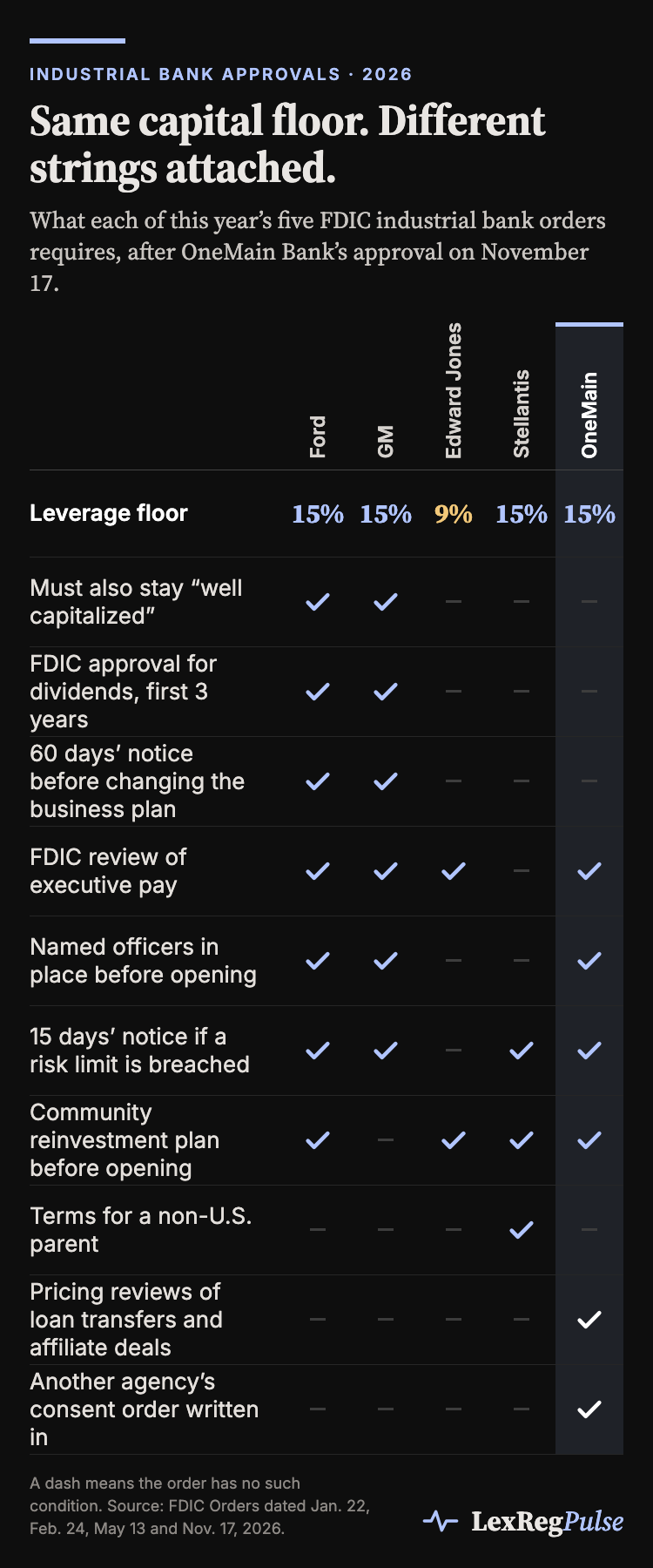
Every order has the same core: a leverage floor, a capital and liquidity support agreement signed up to the ultimate parent, and FDIC sign-off on board and senior executive changes for three years. The rest differs by applicant.
Ford Credit Bank (Order dated January 22; 25 conditions)
- Initial capital of $1.5 billion. A 15 percent tier 1 leverage floor, plus a requirement to stay well capitalized.
- Signers besides the bank: Ford Motor Credit, Ford Holdings, Ford.
- Buys contracts from independent dealers, funded by online savings and CDs.
- Three years of prior approval for dividends. Sixty days' notice before a business-plan change, 15 days' notice of a risk-limit breach, a CRA Strategic Plan.
- Its own: a Chief Credit Officer and a Chief Audit Executive in place before opening, and two added directors.
GM Financial Bank (Order dated January 22; 25 conditions)
- Initial capital of $667 million. A 15 percent tier 1 leverage floor, plus a requirement to stay well capitalized.
- Signers besides the bank: GM Financial, GM Holdings, GM.
- Buys auto loans originated by GM Financial, funded by online savings and time deposits.
- Three years of prior approval for dividends. Sixty days' notice before a business-plan change, 15 days' notice of a risk-limit breach.
- Its own: a credit decisioning engine built and tested before opening, and a Chief Compliance Officer.
Edward Jones Bank (Order dated February 24; 16 conditions)
- Initial capital of $330 million. A 9 percent leverage floor.
- Signers besides the bank: EJB Holding, JFC Holding, Jones Financial.
- Makes securities-based loans, funded by client sweep deposits and CDs.
- FDIC non-objection to executive pay, a CRA Strategic Plan.
- Its own: FDIC approval of any change in proposed management before opening.
Stellantis Bank USA (Order dated May 13; 17 conditions)
- Initial capital of $150 million. A 15 percent leverage floor.
- Signers besides the bank: Stellantis Financial Services U.S., FCA North America Holdings, Stellantis N.V.
- Buys contracts from independent dealers, funded by online NOW, savings, money market and CD accounts.
- Fifteen days' notice of a risk-limit breach, a CRA Strategic Plan.
- Its own: FDIC approval for any transaction with a non-U.S. affiliate, and the parent's consent to U.S. jurisdiction.
OneMain Bank (Order dated November 17; 20 conditions)
- Initial capital of $341 million. A 15 percent leverage floor.
- Signers besides the bank: OneMain Holdings, OneMain Finance.
- Originates loans and sells most to its parent, funded by brokered deposits and a nominal amount of retail savings.
- FDIC non-objection to executive pay, 15 days' notice of a risk-limit breach, a CRA Strategic Plan, a Chief Financial Officer named before opening.
- Its own: an independent valuation of the initial loan transfer, a market-terms review of three affiliate agreements, and the CFPB consent order.
All five orders lapse if insurance is not effective within 12 months; Edward Jones's says one year.
What the shrinking orders mean
The January orders ran 25 conditions; the later three ran 16 to 20. Most of the gap is regulation restated. Ford and GM carry explicit conditions to stay within the business plan, give 60 days' notice of a major deviation, comply with Part 354 and clear parent service contracts. Section 354.5 already imposes the business-plan and contract restrictions on every covered company. Dropping the restated text costs nothing.
Dividends are the exception. Part 354 has no dividend restriction, and only the two January orders require three years of prior approval. For a bank built to sell most of its production to its parent, distributions are the main path by which value leaves. That leaves the 15 percent floor and the CLMA to do the work.
One drafting change is harder to read. Ford, GM and Stellantis route non-objections to the FDIC Regional Director; OneMain routes every one to "the FDIC." The Order gives no reason.
What to watch
For the next consumer finance parent, the pattern is readable. Expect the core: a 15 percent floor unless the asset mix resembles Edward Jones's, both written agreements signed up to the ultimate parent, a CRA Strategic Plan and a board majority independent of the parent. Then expect conditions built from your own file. GM's business plan called for a credit engine, so GM must test one. Stellantis, with a Netherlands-based parent, got foreign-affiliate and jurisdiction conditions. OneMain got its CFPB order written into the approval. An applicant with an open consent order at any agency should assume the FDIC will import it, so map compliance before filing. An originate-to-sell applicant should commission the Reg W valuation and market-terms work before the FDIC asks.
The process changes for whoever files next. FIL-48-2026 (August 10, 2026) moves applications received after August 15, 2026 to two phases: a contingent authorization within 120 days, then an approval and FDI Order within the following 12 months. OneMain's March 2025 filing predates it. The FIL leaves Part 354 untouched. It changes when an applicant learns its conditions.
Before opening, OneMain Bank must name a CFO, clear compensation, deliver both pricing analyses, finalize its CRA plan, sign both written agreements, then pass a pre-opening visitation. It also needs its Utah charter. For the four earlier banks, the Utah Department of Financial Institutions announced conditional charter approval the day the FDIC announced; its news page showed no OneMain announcement when checked for this piece. The Order lapses November 17, 2027 unless insurance takes effect or the FDIC extends it.
Sources
- FDIC, OneMain Bank Order and Statement (Nov. 17, 2026): https://www.fdic.gov/onemain-bank-order-and-statement.pdf
- FDIC, Stellantis Bank USA Order and Statement (May 13, 2026): https://www.fdic.gov/stellantis-bank-usa-order-and-statement.pdf
- FDIC, Edward Jones Bank Order and Statement (Feb. 24, 2026): https://www.fdic.gov/edward-jones-bank-order-and-statement.pdf
- FDIC, Ford Credit Bank Order and Statement (Jan. 22, 2026): https://www.fdic.gov/ford-order-and-statement.pdf
- FDIC, GM Financial Bank Order and Statement (Jan. 22, 2026): https://www.fdic.gov/gm-order-and-statement.pdf
- FDIC press release, OneMain Bank (Nov. 17, 2026): https://content.govdelivery.com/accounts/USFDIC/bulletins/43315d3
- FDIC press release, Stellantis Bank USA (May 14, 2026): https://content.govdelivery.com/accounts/USFDIC/bulletins/41751f1
- FDIC press release, Edward Jones Bank (Feb. 27, 2026): https://content.govdelivery.com/accounts/USFDIC/bulletins/40be1c8
- FDIC press release, Ford Credit Bank and GM Financial Bank (Jan. 22, 2026): https://content.govdelivery.com/accounts/USFDIC/bulletins/4059c9d
- FDIC FIL-48-2026, Revised Procedures for Processing Federal Deposit Insurance Applications: https://www.fdic.gov/news/financial-institution-letters/2026/revised-procedures-processing-federal-deposit-insurance
- FDIC, Summary of New Deposit Insurance Application Activities (pending applications, data as of Nov. 10, 2026): https://www.fdic.gov/bank-examinations/summary-new-deposit-insurance-application-activities
- CFPB enforcement action, OneMain Financial Holdings, LLC et al.: https://www.consumerfinance.gov/enforcement/actions/onemain-financial-holdings-llc-et-al/
- Utah Department of Financial Institutions, News: https://dfi.utah.gov/resources/news/
- 12 CFR Part 354: https://www.ecfr.gov/current/title-12/part-354
- 12 CFR 324.10: https://www.ecfr.gov/current/title-12/section-324.10