FORWARD-LOOKING: If the Fed Indexes Its Asset Thresholds, Which Banks Change Tiers — and Who Do They Beat?
Scenario analysis of Bowman's plan to index Fed asset thresholds for inflation—GDP math on the $100B, $250B, and $700B Category II lines and who wins.
This is scenario analysis. No proposal exists. On October 6, Vice Chair for Supervision Michelle Bowman told the Community Banking Research Conference in St. Louis that "later this year, the Board will consider updates to fixed-dollar asset thresholds in the Board's regulations to account for inflation and economic growth," with "a mechanism to update them every five years." The arithmetic is easy. It lands almost exactly on the 50 percent figure TD Cowen's Jaret Seiberg floated to clients, along with his view that the Fed has the leeway to do it, according to American Banker. The law is harder. Two of the three lines Seiberg cited, $100 billion and $250 billion, are partly written into the U.S. Code. The line the Board can move cleanly is $700 billion, which means the largest durable winner from indexing is not a $120 billion regional. It is a bank sitting near the Category II line.
What Bowman committed to, and what she only previewed
The speech made one concrete commitment and one preview. The commitment: a proposal that "will increase static thresholds, with a mechanism to update them every five years." The preview: "Later this year, the Board will consider broader structural reforms to bank portfolios defined by asset size and updates to the large bank tailoring framework." She also questioned the $10 billion community bank line, noting it has stood "for the past 15 years," and called the Fed's merger competitive analysis "antiquated."
Neither sentence names a number. Reuters reported on September 25, citing four people familiar with the plan, that the Fed is weighing a top line "closer to $1 trillion" and moving some $100 billion requirements "closer to $150 billion." It added that stress tests at $100 billion and enhanced standards above $250 billion are requirements "only Congress can change." Our October 7 brief (lexregpulse.com/brief/2026-10-07) covered the supervisory reorganization. This post models the thresholds.
The template already exists. The Board's Regulation O proposal (91 FR 49526, August 4) adjusted each threshold "using nominal GDP from the fourth quarter of 1994 to the fourth quarter of 2025," rounded the results down to whole multiples, and would re-index every five years without adjusting downward when GDP shrinks. Every limit would rise fourfold. Board staff described the approach as "aligned with the recent GSIB surcharge proposal," so the method is already migrating toward large-bank rules. Comments on the Fed's version now close November 4 (91 FR 64121).
The arithmetic nobody published
Using BEA nominal GDP from FRED, fourth quarter to fourth quarter (CPI-U, December to December):
| Threshold | Base year | Nominal GDP multiple to Q4 2025 | Indexed (GDP) | Indexed (CPI-U, Dec.) |
|---|---|---|---|---|
| $100B / $250B | 2018 (EGRRCPA) | 1.50x | $150B / $376B | $129B / $323B |
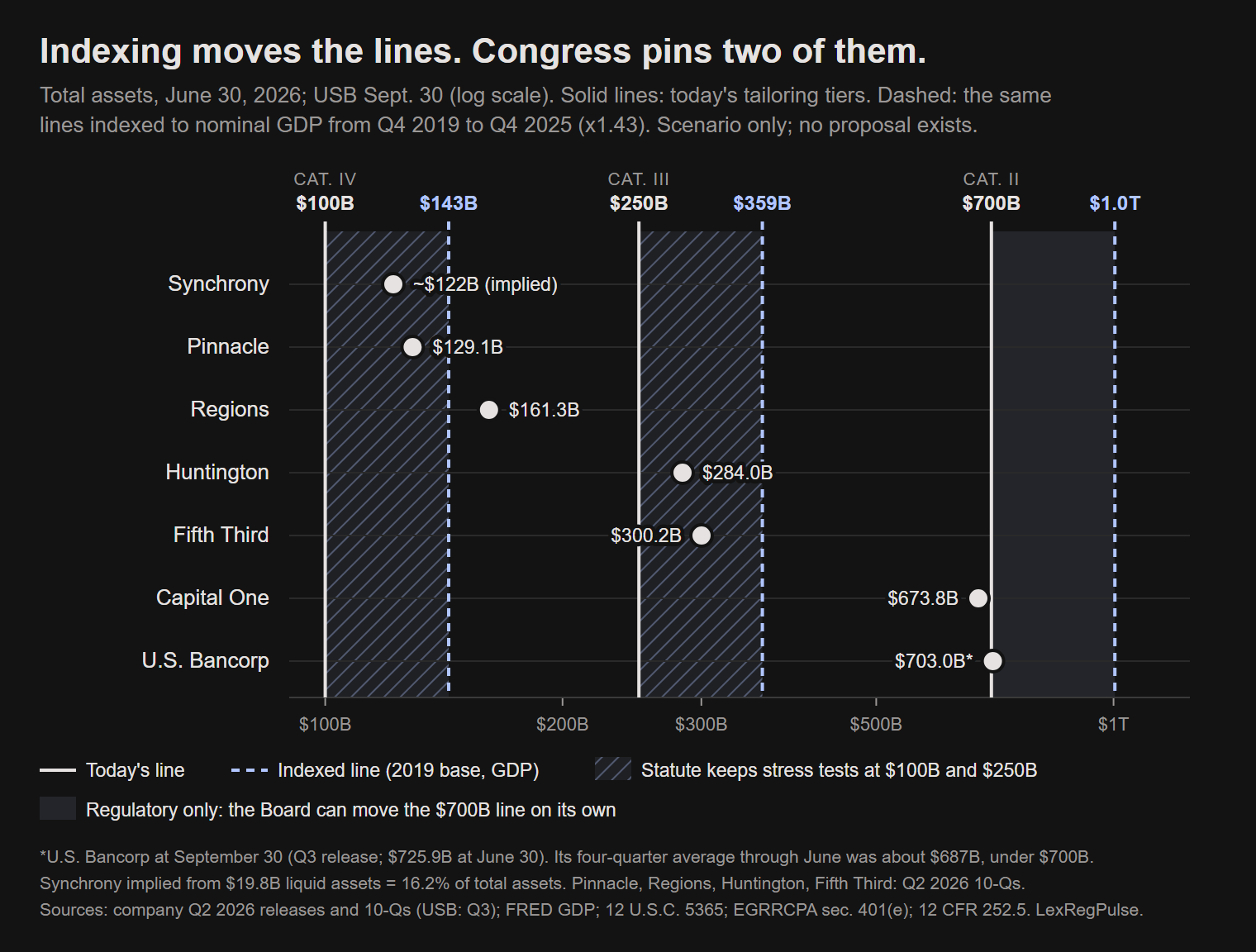
| $100B / $250B / $700B | 2019 (tailoring rule) | 1.43x | $143B / $359B / $1.0T | $126B / $315B / $882B |
| $10B community line | 2010 | 2.06x | $20.6B | $14.8B |
Seiberg's 50 percent matches a 2018 base year, the year Congress enacted the Economic Growth, Regulatory Relief, and Consumer Protection Act. Use 2019, the year the Board finalized tailoring, and the Category III line lands near $360 billion instead of $375 billion. CPI cuts the increase by about two-fifths. The Board's Regulation O question 1 asks for comment on exactly this GDP-versus-CPI choice.
One detail the Regulation O template exposes: rounding down to "multiples of the existing thresholds" works when the GDP ratio is 4.2, as it was from 1994. At 1.4 or 1.5, it rounds to 1x, meaning no change at all. The tailoring proposal will need a different rounding rule. The periodic-indexing rule in the same proposal rounds to the nearest two significant digits, which would yield $140 billion, $360 billion and $1 trillion on a 2019 base.
Who sits in the bands
Figures come from company releases and 10-Qs, pending third-quarter FR Y-9C data.
- $100 billion to $140–150 billion: Pinnacle Financial Partners, which closed its Synovus merger on January 1 and reported $129.1 billion of assets at June 30; its 10-Q says it is now a Category IV firm. Synchrony Financial, at roughly $122 billion on June 30, implied by its liquidity disclosure. Regions, at $161 billion and Category IV, sits above either indexed line. Reuters says Western Alliance and Zions could grow past $100 billion without all of today's requirements.
- $250 billion to $360–380 billion: Fifth Third, at $300 billion on June 30 after closing Comerica in early February; Huntington, at $284 billion after closing Cadence the same week. Both pushed past $250 billion by acquisition this year. Fifth Third's 10-Q says it begins the transition from Category IV to Category III standards in the third quarter; Huntington's 10-Q does not give a date.
- $700 billion to about $1 trillion: Reuters put a GDP-indexed top line near $960 billion. Capital One, a Category III firm, reported $673.8 billion at June 30 and $682.1 billion in average Q2 assets. U.S. Bancorp reported $703.0 billion at September 30, down from $725.9 billion at June 30 and just over the line at quarter-end. Its average assets for each of the four quarters through June ran $680–695 billion, so its four-quarter average sat under $700 billion. J.P. Morgan analyst Vivek Juneja wrote in January that, in his view, U.S. Bancorp has used securitizations and asset sales to delay reaching $700 billion. Further out, and also named by Reuters: PNC at $627.8 billion (September 30) and Truist at $556.0 billion (June 30).
What changes, and what Congress won't let change
Section 165 of Dodd-Frank, as amended in 2018, sets enhanced prudential standards at $250 billion (12 U.S.C. 5365(a)(1)) and requires "annual analyses," the supervisory stress test, for those firms (5365(i)(1)(A)). A separate EGRRCPA provision says the Board "shall, on a periodic basis, conduct supervisory stress tests" of holding companies between $100 billion and $250 billion. The Board can raise thresholds above the statutory line only for subsections (c) through (g), and only on a Financial Stability Oversight Council recommendation (5365(a)(2)(B)). Stress testing is subsection (i).
Bowman said "Congress has given the federal banking agencies discretion to modify thresholds and to tailor requirements." In January she drew the line herself: the Fed would "reconsider these regulatory thresholds and will work to support Congress in updating thresholds that have become outdated." That is the right reading. Indexing a dollar figure Congress wrote would take Congress.
So an indexed Category III line would produce a hybrid. Fed staff said as much in 2019, when they advised against indexing: doing it for "certain thresholds, but not the statutorily prescribed thresholds, would add complexity and potential discontinuity to the framework." Using the Fed's 2019 tailoring chart and today's liquidity rule, a firm between $250 billion and the indexed line would shed the supplementary leverage ratio and the countercyclical buffer. If its weighted short-term wholesale funding is under $75 billion, it would also trade the 85 percent daily LCR and 85 percent NSFR for Category IV treatment: 70 percent, with the LCR calculated monthly, if that funding is $50 billion or more, and no LCR or NSFR at all below $50 billion. Internal liquidity stress tests would move from monthly to quarterly. Some things stay because the statute keeps them for every firm at $250 billion or more: annual supervisory stress tests, periodic company-run tests, single-counterparty credit limits (5365(e)) and resolution plans (5365(d)). Moving the last two would take the Council route in 5365(a)(2)(B).
What each category carries today:
| Category I | Category II | Category III | Category IV | |
|---|---|---|---|---|
| Who | U.S. GSIBs | $700B+ assets or $75B+ cross-jurisdictional activity | $250B+ assets, or $75B+ in nonbank assets, wSTWF or off-balance-sheet exposure | $100B to $250B assets |
| Stress testing | Annual supervisory and company-run; annual capital plan | Annual supervisory and company-run; annual capital plan | Annual supervisory; company-run every other year; annual capital plan | Supervisory every other year; annual capital plan |
| Capital extras | GSIB surcharge, advanced approaches, enhanced SLR, countercyclical buffer, TLAC | Advanced approaches, SLR, countercyclical buffer | SLR, countercyclical buffer | None |
| AOCI in capital | Required | Required | Opt-out allowed | Opt-out allowed |
| LCR and NSFR | 100%, daily LCR | 100%, daily LCR | 85% (100% if wSTWF is $75B+), daily LCR | 70%, monthly LCR, if wSTWF is $50B+; none below |
| FR 2052a liquidity reporting | Daily | Daily | Monthly (daily if wSTWF is $75B+) | Monthly |
| Internal liquidity stress tests | Monthly | Monthly | Monthly | Quarterly |
| Single-counterparty credit limits | Yes | Yes | Yes | No |
wSTWF: weighted short-term wholesale funding. Source: the Fed's 2019 tailoring chart, with NSFR levels as finalized in October 2020. Foreign banks' U.S. operations are sorted on a parallel basis. Categories use four-quarter averages.
The AOCI opt-out does not change at this line. Category III and Category IV firms both have it today. Regions shows what it is worth: CET1 of 10.7 percent, or 9.5 percent including AOCI.
The opt-out ends at Category II, which is pure regulation. Under the 2019 chart, crossing $700 billion brings full daily LCR, advanced approaches, annual company-run tests and daily FR 2052a reporting. Capital One carried a $6.3 billion AOCI loss against $516.3 billion of risk-weighted assets at June 30, about 120 basis points of CET1 that the opt-out keeps off its ratio. A line near $1 trillion gives it roughly $280 billion to $320 billion of runway. That is the most valuable single change in the scenario, and nothing in the statute stops it. One caveat: the agencies' March 19 capital proposals would require Category III and IV firms to recognize most AOCI after a transition. If that is finalized as proposed, the opt-out's value at this line shrinks toward zero and the runway is worth less.
Two traps sit inside the rule text. Category III also attaches at $75 billion of nonbank assets, weighted short-term wholesale funding or off-balance-sheet exposure; if the Board indexes only the headline asset line, a large regional with heavy unfunded commitments could stay in Category III anyway. The trap is already live at Category II, which also attaches at $75 billion of cross-jurisdictional activity. American Express, with $309 billion of assets, told Bowman in May that it "exceeded the Category II threshold as of Q1 2026"; its 10-Q names cross-jurisdictional activity as the trigger. And under 12 CFR 252.5, a firm leaves a category only after four consecutive quarters below the line, unless the final rule grants transition relief.
Who beats whom
Pinnacle and Regions compete across the Southeast. Under a $140 billion line, Pinnacle could drop Category IV's capital plan, internal liquidity requirements and monthly liquidity reporting while still facing the statutory periodic stress test. Regions keeps all of it. The gap is real but narrower than headline indexing implies, and a CPI index ($126 billion) would leave Pinnacle in Category IV.
The bigger shift is M&A math. Category IV banks below $250 billion would gain roughly $110 billion to $125 billion of acquisition room before the Category III regulatory step. Fifth Third and Huntington paid that step already. Competitors that waited would get it at a discount.
The second asymmetry: $10 billion and credit unions
The $10 billion lines that bind hardest are statutory: the Durbin cap on debit interchange (EFTA section 920(a)(6)), CFPB supervision (12 U.S.C. 5515 and 5516) and eligibility for the community bank leverage ratio (EGRRCPA section 201). The Board's September 25 order approving Peoples Bancorp's acquisition of Citizens National (FRB Order No. 2026-24) records a commenter's remark that Peoples plans to sell assets to keep the combined firm below $10 billion. Pro forma assets: $9.7 billion. Fed indexing alone would not end that kind of balance-sheet management; Congress would have to move those lines. H.R. 10184 would raise the CFPB line to $30 billion, and the FDIC proposed on June 25 to lift its deposit-insurance assessment line to $30 billion. Both sit well above the $20.6 billion our GDP arithmetic gives.
The same order shows Bowman's merger critique in a single number. In the Pikeville, Kentucky, market the deal raised HHI by 294 points to 3158. Counting one qualifying credit union at the Fed's customary 50 percent weight moved it to 293 points and 3153. The Fed's own guidance says credit unions are considered only after a deal fails the initial screen, and "it has been very rare" for one to receive more than 50 percent weight. The FDIC's September 22 merger proposal (91 FR 60196) would include credit union shares in its competitive analysis, according to Reed Smith. If the Fed follows, rural bank deals clear more easily. For credit unions the change cuts both ways. Being counted confirms they compete with banks, which makes it harder to oppose a bank merger on the ground that it leaves a rural market with too few choices.
The discipline question
Bowman ties this agenda to the Starling review. In her September 18 summary, Starling found supervisors "knew, or should have known" about SVB's vulnerabilities as early as March 2022, and that delays "were not caused by the regulatory tailoring mandate." The Fed's 2019 tailoring chart listed SVB among firms with $50 billion to $100 billion in assets. Brian Peters of the Perspective on Risk newsletter argues the failure point was SVB's 2021 move into the large-bank portfolio: "The axis that matters is size, and that is the one deferred to 'later this year.'" Thomas Hoenig, asked about the reorganization, told Medill News Service that consolidating supervision "by itself will not really make supervision more efficient, nor necessarily more effective."
To be fair to Bowman, the statute itself tells the Board to avoid "sharp, discontinuous changes" (5365(b)(3)(B)). Static lines produce exactly those, and banks shape their balance sheets around them, as Peoples and U.S. Bancorp show. That is a real argument.
It does not settle the SVB problem. Starling, as Bowman summarized it, cleared the tailoring mandate of causing supervisory delay. Her summary says nothing about whether lighter capital and liquidity rules mattered. Indexing lengthens the runway a fast-growing bank spends in a lighter tier. The defense against that is the statutory stress-test floor, which is why Congress's hard-coded lines matter more than the Board's indexing formula.
What to watch
The proposal, if it lands "later this year," will answer five questions: base year, GDP or CPI, rounding, whether the $75 billion indicators index with the asset lines, and transition timing. Watch whether the Board seeks a Council recommendation under 5365(a)(2)(B). That would signal it intends to test the statutory lines. Congress could move them itself: the House TIER Act (H.R. 6553), which Senate Banking Republicans said in February had passed the Financial Services Committee, would lift section 165's $250 billion line to $370 billion and index statutory thresholds every five years. Sen. Katie Britt introduced a Senate version in September. Regulation O comments close November 4; FDIC merger comments close November 23.
Banks near a line should model both base years, comment on the indicator and rounding questions, and build two-case M&A models. They should not shed assets, defer Category III readiness or restructure funding on a proposal that does not exist.
Bottom line
Bowman has all but promised indexing, and the arithmetic favors banks near every large-bank line. But Congress wrote the stress-test lines at $100 billion and $250 billion, so the regional banks Seiberg's math seems to rescue get a partial reprieve. The clean, durable win sits at $700 billion, where Capital One and U.S. Bancorp would gain years of runway and keep an AOCI opt-out worth about 120 basis points of CET1 to Capital One, unless the pending capital proposal takes the opt-out away first.
Sources
- Bowman, "Modernizing the Regulatory and Supervisory Landscape," October 6, 2026: https://www.federalreserve.gov/newsevents/speech/bowman20261006a.htm
- Bowman, "Modernizing Supervision and Regulation: 2025 and the Path Ahead," January 7, 2026: https://www.federalreserve.gov/newsevents/speech/bowman20260107a.htm
- Bowman, "Initial Findings from Independent Review of Silicon Valley Bank," September 18, 2026: https://www.federalreserve.gov/newsevents/speech/bowman20260918b.htm
- Federal Reserve, Regulation O proposal, 91 FR 49526 (August 4, 2026): https://www.federalregister.gov/documents/2026/08/04/2026-15777/loans-to-executive-officers-directors-and-principal-shareholders-of-member-banks-bank-holding
- Federal Reserve, Regulation O comment extension, 91 FR 64121 (October 7, 2026): https://www.federalregister.gov/d/2026-20509
- Federal Reserve staff memo, Regulation O proposal (June 30, 2026): https://www.federalreserve.gov/newsevents/pressreleases/files/bcreg20260731b1.pdf
- Federal banking agencies, capital framework proposals (March 19, 2026): https://www.federalreserve.gov/newsevents/pressreleases/bcreg20260319a.htm
- 12 CFR 252.5 (eCFR): https://www.ecfr.gov/current/title-12/chapter-II/subchapter-A/part-252/subpart-A/section-252.5
- 12 CFR 249.30(c) and 249.105(b), LCR and NSFR adjustment percentages (eCFR): https://www.ecfr.gov/current/title-12/chapter-II/subchapter-A/part-249
- Federal Reserve staff memo on the final tailoring rules (October 3, 2019, for the October 10 Board meeting): https://www.federalreserve.gov/aboutthefed/boardmeetings/files/tailoring-board-memo-20191010.pdf
- Federal Reserve, "Agencies issue final rule to strengthen resilience of large banks" (NSFR final rule, October 20, 2020): https://www.federalreserve.gov/newsevents/pressreleases/bcreg20201020b.htm
- Federal Reserve tailoring rule visual (October 10, 2019): https://www.federalreserve.gov/aboutthefed/boardmeetings/files/tailoring-rule-visual-20191010.pdf
- 12 U.S.C. 5365 and EGRRCPA §401 notes (LII): https://www.law.cornell.edu/uscode/text/12/5365
- 15 U.S.C. 1693o-2(a)(6), EFTA section 920 (LII): https://www.law.cornell.edu/uscode/text/15/1693o-2
- 12 U.S.C. 5515 and 5516 (LII): https://www.law.cornell.edu/uscode/text/12/5515 ; https://www.law.cornell.edu/uscode/text/12/5516
- EGRRCPA section 201, 12 U.S.C. 5371 note (LII): https://www.law.cornell.edu/uscode/text/12/5371
- FDIC, FIL-31-2026, assessment thresholds proposal (June 25, 2026): https://www.fdic.gov/news/financial-institution-letters/2026/notice-proposed-rulemaking-assessments-thresholds-rate
- PYMNTS, on H.R. 10184 (September 2, 2026): https://www.pymnts.com/legal/cfpb/2026/house-bill-would-rewrite-cfpb-supervision-enforcement-rules/
- H.R. 6553, TIER Act of 2025 (introduced December 10, 2025): https://www.congress.gov/119/bills/hr6553/BILLS-119hr6553ih.htm
- Senate Banking Committee Republicans, letter to the federal banking agencies on indexing (February 25, 2026): https://punchbowl.news/wp-content/uploads/2.25.26-Letter-to-Prudential-Regulators-on-Indexing.pdf
- ABA Banking Journal, "Senate bill would create process for raising bank regulatory thresholds" (September 23, 2026): https://bankingjournal.aba.com/2026/09/senate-bill-would-create-process-for-raising-bank-regulatory-thresholds/
- FRB Order No. 2026-24, Peoples Bancorp (September 25, 2026): https://www.federalreserve.gov/newsevents/pressreleases/files/orders20260925a1.pdf
- Federal Reserve competitive-analysis FAQs: https://www.federalreserve.gov/bankinforeg/competitive-effects-mergers-acquisitions-faqs.htm
- FDIC, Merger Transactions proposal, 91 FR 60196 (September 22, 2026): https://www.federalregister.gov/documents/2026/09/22/2026-19308/merger-transactions
- FRED, Gross Domestic Product, quarterly SAAR (BEA): https://fred.stlouisfed.org/series/GDP
- FRED, CPI-U, seasonally adjusted (BLS): https://fred.stlouisfed.org/series/CPIAUCSL
- Capital One Q2 2026 earnings release and supplement: https://investor.capitalone.com/news-releases/news-release-details/capital-one-reports-second-quarter-2026-net-income-30-billion-or
- U.S. Bancorp Q2 2026 earnings release and supplement (SEC): https://www.sec.gov/Archives/edgar/data/36104/000003610426000039/a2q26earningssupplement.htm
- U.S. Bancorp Q3 2026 earnings release (SEC, October 15, 2026): https://www.sec.gov/Archives/edgar/data/0000036104/000003610426000054/a3q26earningsrelease.htm
- PNC Q3 2026 financial highlights (SEC, October 15, 2026): https://www.sec.gov/Archives/edgar/data/0000713676/000162828026065936/q32026financialhighlightsa.htm
- Truist Q2 2026 Form 10-Q: https://www.sec.gov/Archives/edgar/data/92230/000009223026000099/tfc-20260630.htm
- Regions Q2 2026 earnings release: https://ir.regions.com/news-events/press-releases/news-details/2026/Regions-Reports-Earnings-of-549-Million-and-EPS-of-0-64-in-2Q-2026/default.aspx
- Regions Q2 2026 Form 10-Q: https://www.sec.gov/Archives/edgar/data/1281761/000128176126000055/rf-20260630.htm
- Synchrony Q2 2026 earnings release: https://investors.synchrony.com/filings-regulatory/sec-filings/all-sec-filings/content/0001601712-26-000030/earningsrelease2q26.htm
- Fifth Third, Comerica merger completion (February 2, 2026): https://ir.53.com/news/news-details/2026/Fifth-Third-Completes-Merger-with-Comerica-to-Become-9th-Largest-U-S--Bank/default.aspx
- Fifth Third Q2 2026 Form 10-Q: https://www.sec.gov/Archives/edgar/data/35527/000003552726000202/fitb-20260630.htm
- Huntington, Cadence merger completion (February 2, 2026): https://ir.huntington.com/news-presentations/press-releases/detail/967/huntington-bank-completes-merger-with-cadence-bank-expanding-presence-across-texas-and-the-south
- Huntington Q2 2026 Form 10-Q: https://www.sec.gov/Archives/edgar/data/49196/000004919626000066/hban-20260630.htm
- American Express, meeting with Vice Chair for Supervision Bowman (May 11, 2026): https://www.federalreserve.gov/regreform/rr-commpublic/american-express-meeting-20260511.pdf
- American Express Q1 2026 Form 10-Q: https://www.sec.gov/Archives/edgar/data/4962/000000496226000192/axp-20260331.htm
- Pinnacle and Synovus merger completion (announced January 2, 2026): https://www.synovus.com/about-us/news/2026/2026-01-02-pinnacle-and-synovus-complete-merger-to-become-regional-bank-growth-champion
- Pinnacle Q2 2026 Form 10-Q: https://www.sec.gov/Archives/edgar/data/2082866/000208286626000082/pnfp-20260630.htm
- American Banker, "Fed's Bowman unveils major overhaul of its bank supervision" (Seiberg estimate): https://www.americanbanker.com/news/feds-bowman-unveils-major-overhaul-of-its-bank-supervision
- Reuters, "US Fed plans to raise bank oversight thresholds, sources say" (September 25, 2026, via The Spokesman-Review): https://www.spokesman.com/stories/2026/sep/25/us-fed-plans-to-raise-bank-oversight-thresholds-so/
- Banking Dive, "Fed's Bowman, lawmakers suggest regulatory threshold changes" (January 8, 2026; Juneja): https://www.bankingdive.com/news/fed-bowman-hill-barr-regulatory-banks-asset-threshold-changes/809121/
- Medill News Service, "Federal Reserve pushes broad overhaul of bank regulation" (Hoenig): https://medillonthehill.medill.northwestern.edu/2026/10/federal-reserve-pushes-broad-overhaul-of-bank-regulation/
- Brian Peters, Perspective on Risk, October 9, 2026: https://perspectiveonrisk.substack.com/p/perspective-on-risk-oct-9-2026-supervisory
- Reed Smith, on the FDIC's September 22 merger proposal: https://www.reedsmith.com/articles/the-fdic-s-proposed-overhaul-of-bank-merger-review-what-financial-institutions-need-to-know/